


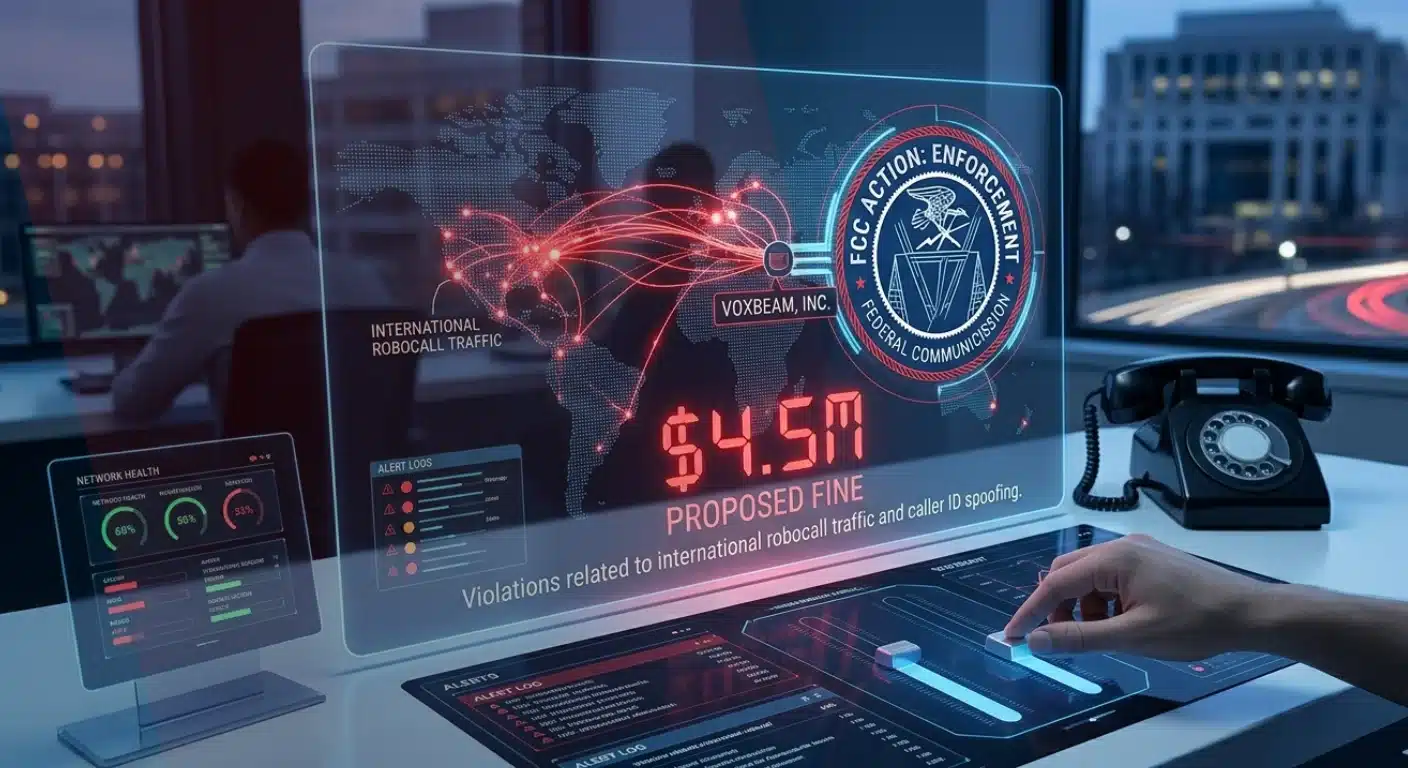
The Federal Communications Commission (FCC) has moved to advantageous Voxbeam Telecommunications $4.5 million, bringing renewed consideration to how overseas name visitors remains to be getting used to push financial institution impersonation scams into the U.S. telecom system. The Voxbeam robocall case stems from an FCC investigation that discovered the corporate allegedly routed suspicious robocalls onto American networks, calls that, below present guidelines, ought to have been blocked earlier than reaching shoppers.
On the middle of the Voxbeam robocall case is a compliance failure that regulators think about basic. U.S. voice suppliers are barred from accepting visitors from operators not listed within the FCC’s Robocall Mitigation Database (RMD). But, in response to the findings, Voxbeam carried calls from Axfone, a Czech Republic-based supplier that has by no means been registered within the database, elevating recent issues about gaps in enforcement and oversight.
FCC Flags Lapses in Voxbeam Robocall Dealing with
The Voxbeam robocall case is constructed round what regulators see as a failure to observe clear compliance necessities. In keeping with the FCC, Voxbeam transmitted tens of hundreds of calls from Axfone into U.S. networks over a brief interval—from March 31 to April 3, 2025.
These weren’t random spam calls. A lot of them appeared to impersonate main monetary establishments, utilizing spoofed numbers linked to fraud departments or customer support traces at banks reminiscent of Financial institution of America and Chase. For recipients, the calls appeared professional, growing the chance of victims partaking with scammers.
The FCC says this type of visitors ought to have been blocked outright. Suppliers listed outdoors the RMD are thought-about high-risk, and accepting their visitors is a direct violation of the foundations.
Dormant Accounts Increase Crimson Flags
What makes the Voxbeam robocall case extra regarding is how the visitors was routed. Investigators discovered that the calls have been linked to an account that had been inactive since 2018.

That element issues. Dormant accounts are sometimes seen as a weak level in telecom networks, as they are often reactivated with out drawing rapid consideration if correct monitoring isn’t in place. On this occasion, the FCC believes Voxbeam didn’t establish and cease a sudden surge of exercise from an account that had been silent for years.
For an trade that handles large volumes of name visitors day by day, this factors to a deeper operational hole—not only a one-off mistake.
Client Hurt Drives FCC Motion
The investigation itself was triggered by a criticism from a monetary establishment. Prospects had reported receiving fraudulent calls that appeared to come back from the financial institution’s official fraud reporting quantity.
That is the place the impression of the Voxbeam robocall case turns into clear. These scams usually are not simply technical violations—they instantly have an effect on shoppers, erode belief in banking techniques, and make fraud more durable to detect.
FCC Chairman Brendan Carr addressed this instantly, stating:
“Corporations like Voxbeam should guarantee they aren’t accepting visitors from sketchy operators. These gateway suppliers are the on-ramps to American cellphone networks and with that enterprise mannequin comes important duty. As we noticed on this case, failure to observe the FCC’s robocall mitigation guidelines can lead to tens of hundreds of scam calls reaching U.S. prospects. The FCC is dedicated to defending shoppers from robocall scams like these.”
A Broader Trade Downside
The Voxbeam robocall case displays a wider problem for regulators. Whereas frameworks just like the RMD are in place, enforcement nonetheless relies upon closely on telecom suppliers doing their due diligence.
And that’s the place issues typically crumble.
Overseas operators, particularly these outdoors regulatory oversight, stay a serious supply of unlawful robocalls. When U.S.-based gateway suppliers fail to vet their companions or monitor uncommon visitors patterns, they successfully open the door to those campaigns.
The proposed $4.5 million penalty is critical, but it surely’s additionally a warning. The FCC is making it clear that merely performing as a pass-through for name visitors is not acceptable.










The Ultimate Download Page Get It Now 2026 https://downsload.netlify.app